


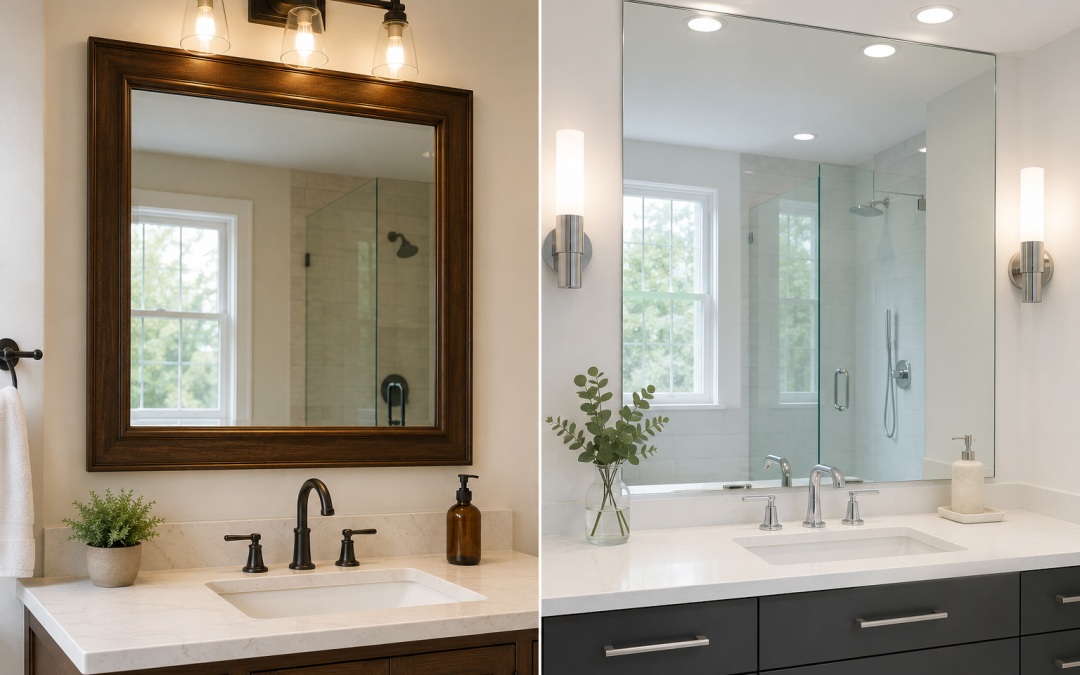
A framed bathroom mirror is a mirror surrounded by a decorative border of wood, metal, or composite material, while a frameless mirror is a single sheet of glass with polished or beveled edges mounted directly to the wall. Both do the same job above your vanity, but they differ in style, how they handle humidity, and how they attach to the wall — and those three differences decide which one belongs in your bathroom.
At Centennial Glass, we have been helping Ottawa homeowners choose and install mirrors since 1967 — over 55 years of cutting, fabricating, and installing custom mirrors of any size or shape in our own facility. Here is how we walk customers through the framed-versus-frameless decision.
What Is a Framed Bathroom Mirror?
A framed bathroom mirror pairs the reflective glass with a finished border that acts like trim for the mirror. The frame defines the mirror as a design element, the same way a picture frame finishes a painting.
Framed mirrors suit bathrooms where the fixtures already make a style statement: a black metal frame echoes matte-black faucets, while warm wood softens a modern vanity. Browse a wall mirror collection and you will see how much personality a frame adds.
Practical advantages of a frame:
- Edge protection. The frame shields the mirror’s edges from knocks and chips.
- Built-in style. The frame coordinates with cabinetry and lighting.
- Easy swaps. A standard framed vanity mirror hangs much like artwork, so updating the look later is simple.
What Is a Frameless Bathroom Mirror?
A frameless bathroom mirror is a custom-cut sheet of mirror glass, typically 1/4 inch thick, with edges that are flat-polished or beveled so they are smooth and finished without any border. It mounts flush to the wall using clips, channels, or adhesive.
Frameless mirrors are the default choice for a clean, contemporary bathroom. Because the glass can be cut to any dimension, a frameless mirror can run wall to wall above a double vanity, fit around outlets and sconces, or fill an awkward alcove exactly. That edge-to-edge reflection also makes small bathrooms feel larger and brighter — one of the classic ways to make the best use of mirrors in your home design.
Practical advantages of going frameless:
- Custom sizing. Cut to the exact width of your vanity or wall.
- Maximum reflection. No border means more light in the room.
- Timeless simplicity. Polished-edge glass does not date the way a trendy frame can.
Style: Statement Piece or Seamless Surface?
The style question comes down to whether you want the mirror to be *seen* or to *disappear*. A framed mirror is furniture for your wall; a frameless mirror is an extension of the wall itself.
If you are renovating a traditional or transitional bathroom, a framed mirror usually wins. If your bathroom leans modern, minimalist, or spa-like — or if you want one mirror spanning a double vanity — frameless is the natural fit. For real-world examples of both approaches, our cut and framed mirror picture gallery shows recent Ottawa installations side by side.
Moisture: How Each Type Handles a Humid Bathroom
Bathrooms are hard on mirrors. Steam, splashes, and temperature swings attack the most vulnerable parts: the frame material and the mirror’s edges.
Framed mirrors are only as moisture-resistant as their frames. Wood and MDF frames can swell, warp, or peel in a poorly ventilated bathroom, especially near the shower; metal, sealed, or composite frames hold up far better. If you love the framed look, choose the frame material accordingly and keep the exhaust fan running.
Frameless mirrors eliminate the frame as a failure point, but their cut edges are exposed to humidity. Quality matters here: properly fabricated mirror glass with cleanly polished edges, installed with the correct adhesives and a small gap off the countertop, resists moisture far longer than a budget mirror glued tight to a damp backsplash. Because we fabricate in-house, we control the cutting, edging, and polishing on every mirror we install — and when an old mirror has finally deteriorated, the right move is simply to replace the mirror glass with a new custom-cut piece.
Good ventilation protects either type. No mirror enjoys sitting in steam for an hour a day.
Mounting: How Each Type Attaches to the Wall
Framed mirrors hang like heavy artwork — on hooks, cleats, or anchors rated for the mirror’s weight. They are forgiving to install and easy to remove, level, or replace.
Frameless mirrors mount flush using mirror clips, J-channel, or mirror adhesive (mastic), often in combination. With no frame to grab, handling a large sheet of glass, levelling it, and bonding it safely is two-person, experienced-hands work — large frameless mirrors should be templated, cut, and installed professionally.
Which Should You Choose?
Choose framed if you want a defined design statement or plan to update your décor over time. Choose frameless if you want custom sizing, a seamless modern look, and maximum light. Many customers blend both: frameless above the main vanity, a framed accent mirror in the powder room.
You do not have to decide alone — our showroom staff help with frame selection, our estimators measure on site, and our installers handle the rest:
“New great looking framed mirror for our bathroom vanity. Thank you to everyone: Kim, Scott, Frazier and Thomas for all your help and for the quick turnaround service. We were very pleased with the excellent service at the front desk and advice for the mirror and frame from Kim; with Frazier for the careful and proper measurements for the new mirror and frame…” — Louise and Kirk Sweet, 5★
And if you are weighing the same question for your shower, the logic carries over — see our guide to frameless vs. framed shower enclosures.
FAQ
Are frameless mirrors more expensive than framed mirrors?
Not necessarily. Cost depends more on dimensions, glass thickness, edge finishing, and installation complexity than on the presence of a frame.
Do frameless mirrors fall off the wall?
Properly installed frameless mirrors are very secure. Failures almost always trace back to wrong adhesives or missing mechanical support. Professional installation with clips or channel plus the correct mastic prevents this.
Can I get a frameless mirror cut to a custom size?
Yes. Frameless mirrors can be cut to virtually any size or shape — wall-to-wall widths, arches, circles, and cutouts for outlets or sconces — which is exactly what in-house fabrication is for.
Which type lasts longer in a bathroom?
With good ventilation and quality fabrication, both last for decades. Framed mirrors fail at the frame first; frameless mirrors fail at the edges if poorly made. Quality and ventilation matter more than the category.
Ready to Choose Your Bathroom Mirror?
Whether you want a statement frame or seamless wall-to-wall glass, Centennial Glass has fabricated and installed mirrors for Ottawa homes for more than 55 years — no project too large or too small. Call us at 613-738-9500 or contact Centennial Glass for a quick quote on your bathroom mirror.