


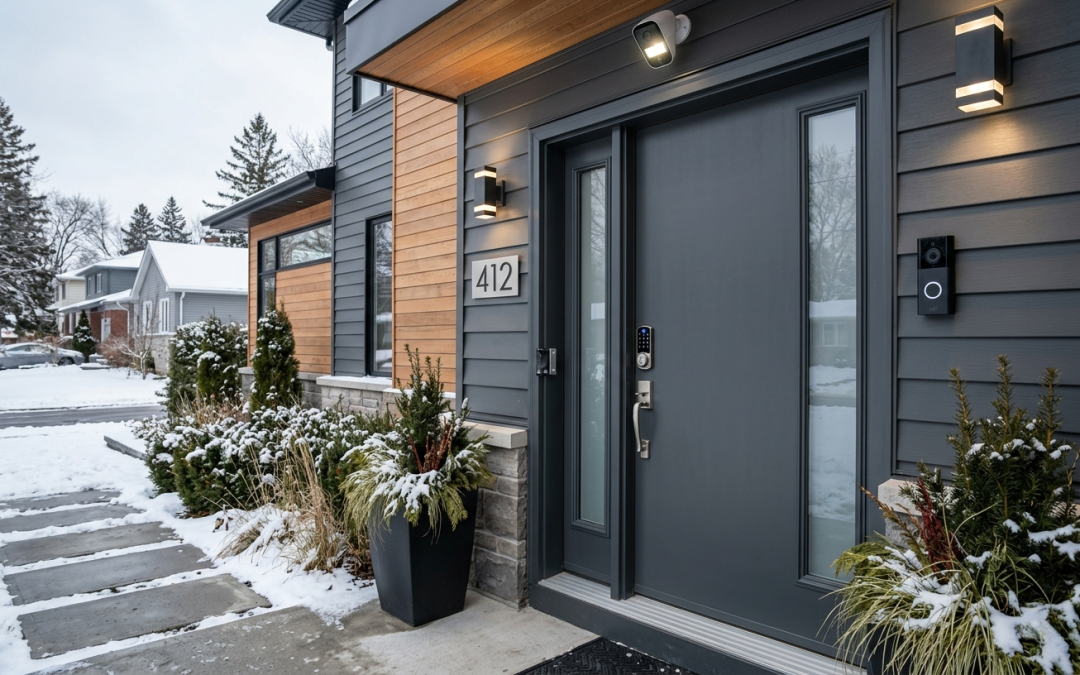
Your entry door is your home’s first line of defence. While most homeowners focus on the door itself, its material and appearance, the security features built into and around the door often matter more than the panel. A beautiful solid door with a weak lock in a flimsy frame offers less protection than a standard door with robust hardware and reinforced construction.
Understanding the security features available helps you make informed decisions whether you’re replacing a front door, upgrading hardware on an existing one, or evaluating the entry points of a home you’re considering purchasing. This guide covers the features that genuinely improve security versus those that provide more perception than protection.
Locking Systems: The Core of Door Security
Deadbolts
The deadbolt remains the foundation of residential door security. Unlike a spring-bolt latch (the mechanism that clicks shut when you close the door), a deadbolt extends a solid metal bolt into the door frame and cannot be retracted without turning the key or thumb turn. This resistance to forced retraction is what makes deadbolts effective.
Not all deadbolts are created equal. Look for these specifications:
Grade ratings follow ANSI/BHMA standards. Grade 1 deadbolts withstand the most abuse, tested to survive 10 strikes with 75 pounds of force and 250,000 cycles. Grade 2 deadbolts meet a slightly lower threshold but remain suitable for most residential applications. Grade 3 is the minimum acceptable standard but offers significantly less resistance to force.
Bolt throw refers to how far the bolt extends into the frame. A minimum one-inch throw is standard; longer throws provide more resistance to prying. Some premium deadbolts extend 1.5 inches or more.
Anti-pick and anti-bump features address two common bypass techniques. Pick-resistant locks use security pins that resist manipulation, while bump-resistant designs prevent a technique that can defeat standard pin tumbler locks in seconds.
Multipoint Locking Systems
Multipoint locks represent a significant upgrade over single-point deadbolts. These systems engage the door at three or more points along the frame, typically at the top, middle, and bottom, using a combination of hooks, bolts, and rollers that all engage with a single turn of the handle or key.
This distributed locking approach offers several advantages. Force applied to one point of the door doesn’t compromise the others. The door seals more evenly against weatherstripping, improving both security and energy efficiency. And the multiple engagement points resist warping and prying more effectively than any single-point system.
Multipoint locks are standard on many European entry doors and increasingly common in Canadian installations, particularly on fiberglass entry doors where the door construction supports the additional hardware.
Smart Locks
Smart locks add convenience and monitoring capabilities to your entry security. Modern smart locks offer multiple access methods including fingerprint recognition, numeric keypads, smartphone apps, key fobs, and traditional keys as backup. Key features to evaluate include:
Remote access allows you to lock or unlock your door from anywhere via a smartphone app, useful for letting in guests, service providers, or family members who’ve forgotten their keys.
Activity logging tracks who enters and exits your home, with timestamps. This feature provides accountability and peace of mind, particularly for families with children arriving home from school.
Temporary access codes let you create time-limited entry codes for house cleaners, dog walkers, contractors, or Airbnb guests, then automatically revoke access when the time expires.
Auto-lock functions ensure your door locks after a set period, eliminating the “did I lock the door?” anxiety.
Integration with home security systems allows smart locks to work with cameras, alarms, and other smart home devices for comprehensive security.
Smart locks can be installed on most standard single-cylinder deadbolts, making them compatible with both new and existing doors. Battery-powered models avoid the need for electrical wiring, though battery life (typically 3 to 12 months) requires monitoring.
The Door Frame: Often the Weakest Link
Most residential break-ins defeat the frame before defeating the lock. A standard wood door frame with short screws and a thin strike plate can be kicked open regardless of how robust the deadbolt is. Reinforcing the frame is arguably the single most impactful security upgrade.
Reinforced Strike Plates
Standard strike plates, the small metal plate where the deadbolt engages the frame, are typically attached with short 3/4-inch screws that grip only the door jamb. Under force, the jamb splits and the door opens. Heavy-duty strike plates use 3-inch or longer screws that extend through the jamb into the structural framing (studs) behind it, distributing force across a much larger area.
Some security strike plates extend the full height of the door, reinforcing the entire lock side of the frame. These provide the highest resistance to kick-in attacks and are relatively inexpensive to install.
Door Frame Reinforcement Kits
Complete frame reinforcement kits wrap the jamb in steel sleeves, protecting both the lock side and hinge side from splitting. These kits are particularly valuable for older Ottawa homes where original wood frames may have weakened with age and moisture exposure. Professional door repair ottawa services can assess frame integrity and recommend appropriate reinforcement.
Hinge Security
Standard door hinges can be a vulnerability, especially on outward-swinging doors where hinge pins are accessible from the outside. Security hinges address this with non-removable pins, setscrew pins that lock in place, or stud-type hinges that interlock even when pins are removed.
For inward-swinging doors (most residential entries), hinge security is less critical but still worth considering. Three hinges rather than two provide better weight distribution and resistance to sagging.
Glass and Security: Finding the Balance
Entry doors with glass inserts present a design-versus-security consideration. A glass panel near the lock can theoretically be broken to reach inside and unlock the door. Several approaches mitigate this risk.
Tempered Glass
Tempered glass is stronger than standard glass and breaks into small, relatively harmless pieces rather than sharp shards. It resists casual break-in attempts but can be defeated with focused impact.
Laminated Glass
Laminated glass bonds two or more glass layers with a plastic interlayer that holds the glass together even when broken. An intruder breaking laminated glass faces a time-consuming and noisy process of working through the layers, a significant deterrent since most break-ins rely on speed and stealth.
Decorative Glass Patterns
Decorative glass with textured patterns obscures the interior view, preventing potential intruders from scooping out your home’s contents or seeing if anyone is home. Options like frosted glass and custom sandblasting patterns combine privacy with style.
Glass Placement Strategy
Glass placement matters. Sidelights (narrow windows flanking the door) and transom windows above the door add light without creating access to the lock. Glass positioned away from the lock hardware reduces the vulnerability of decorative inserts. Statement entries with exterior double doors can incorporate both light and security when designed properly.
Additional Security Features Worth Considering
Door Viewers and Cameras
A quality door viewer (peephole) with a wide-angle lens lets you identify visitors before opening. Modern video doorbells and door cameras extend this capability with smartphone alerts, two-way audio, night vision, and recorded footage, valuable for package delivery monitoring, visitor screening, and evidence collection.
Security Film for Glass
Applied to glass panels, film for windows security holds broken glass in place and significantly increases the time and effort required to breach a glass insert. This is a cost-effective upgrade for existing doors with glass that you’d rather not replace.
Door Reinforcement Bars and Braces
Interior security bars brace against the door and floor, providing additional resistance to forced entry. While primarily intended for situations requiring heightened security (travel, for instance), some homeowners use them routinely for overnight peace of mind.
Weatherstripping and Seal Quality
While primarily an energy efficiency feature, tight weatherstripping and seals make doors harder to pry. Gaps between the door and frame give pry tools purchase; well-sealed doors eliminate this vulnerability while also improving thermal performance and reducing drafts. The same sealing principles apply to insulated glass units in adjacent windows.
Evaluating Your Current Entry Security
Walk through your home’s entry points with these questions:
- Deadbolt quality: Is your deadbolt Grade 1 or Grade 2? Does the bolt extend at least one inch?
- Strike plate: Are screws 3 inches or longer? Does the strike plate feel solid when you push on it?
- Frame condition: Is the door frame solid with no signs of rot, splitting, or softness?
- Hinge integrity: Are hinges secure with no visible looseness or sagging?
- Glass vulnerability: Can glass panels near locks be reached from outside?
- Lock alignment: Does the deadbolt engage smoothly without forcing? Misalignment indicates frame shifting that weakens security.
- Door fit: Does the door close tightly without gaps? Visible light around edges suggests seal and security issues.
Layered Security: The Most Effective Approach
No single feature provides complete security. The most effective approach layers multiple features so that defeating one doesn’t compromise the entire system. A well-secured entry combines a solid door panel, Grade 1 or 2 deadbolts (ideally multipoint), reinforced strike plates with long screws, secure hinges, and quality weather seals.
Smart locks and cameras add monitoring and convenience. Security film protects glass inserts. And good exterior lighting around entries deters opportunistic intruders, most burglars avoid well-lit, clearly visible entry points.
Professional Security Assessment Across the Ottawa Region
For homeowners evaluating their front doors ottawa security, professional assessment can identify specific vulnerabilities in your current setup and recommend targeted upgrades that provide the greatest security improvement for your investment.
Whether you’re in Kanata, Orleans, Nepean, or Stittsville, local expertise ensures security recommendations account for the specific construction styles and risk profiles of homes in your area. Surrounding communities including Manotick and Carleton Place are also served.
For damaged or compromised glass inserts in existing doors, professional glass repair services restore both appearance and security. In emergency situations, emergency glass repair services address break-in damage quickly to secure your home.
Ready to upgrade your entry door security? Contact us to schedule a consultation with our team of door installation specialists.