


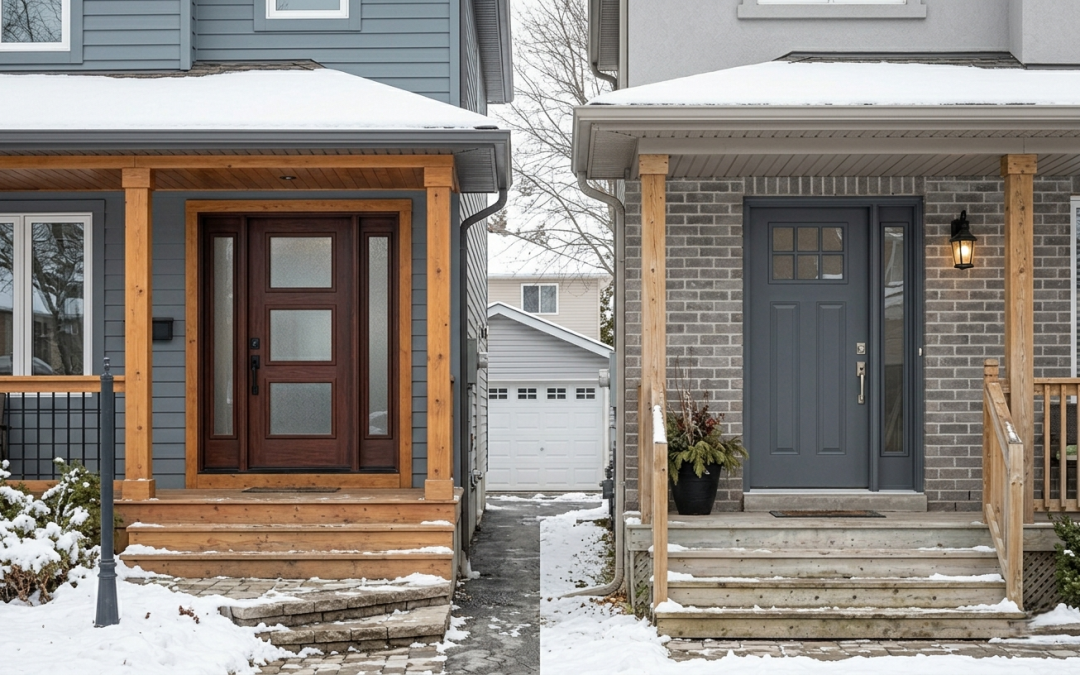
Your entry door handles more punishment than almost any other component of your home. It endures thousands of openings and closings each year, absorbs direct weather exposure, maintains a thermal barrier between conditioned interior air and Ottawa’s temperature extremes, and serves as your home’s primary security point. Choosing between fibreglass and steel, the two dominant materials for entry doors ottawa homeowners install most often, requires understanding how each performs under the specific demands of Ottawa’s climate.
Both materials outperform traditional wood doors in nearly every measurable category. The real question isn’t whether fibreglass or steel is “better” in the abstract. It’s which material matches your priorities for energy performance, security, aesthetics, maintenance, and budget.
How Entry Doors Are Actually Constructed
Neither residential fibreglass nor steel doors are solid slabs of their namesake material. Understanding their construction clarifies why each performs as it does.
Steel Door Construction
Steel entry doors consist of a thin steel shell, typically 24-gauge galvanized steel, roughly 1/40th of an inch thick, wrapped around a polyurethane or polystyrene insulating foam core. The steel exterior is coated with zinc or other alloys to resist corrosion. A standard 36″ × 80″ steel door weighs between 60 and 100 pounds.
Fibreglass Door Construction
Fibreglass entry doors use a moulded fibreglass skin, the same composite material used in aircraft body panels and marine hulls, over a reinforced foam or composite core, typically polyurethane. The fibreglass exterior can be manufactured with realistic wood grain textures that closely replicate oak, mahogany, or cherry. Weight is comparable to steel at 50 to 100 pounds for a standard-size door.
Both constructions derive their insulating value primarily from the foam core rather than the exterior skin. This explains why their insulation ratings are similar, but their real-world thermal performance differs in important ways.
Energy Performance in Ottawa’s Climate
On paper, fibreglass and steel doors deliver comparable insulation values. Both typically rate between R-5 and R-6 when manufactured with quality foam cores. Wood doors, by comparison, generally achieve only R-2 to R-3. However, R-value alone doesn’t tell the complete story for homeowners facing winter temperatures that regularly drop below -25°C.
Thermal Conductivity Differences
The critical difference is thermal conductivity. Steel conducts heat and cold; fibreglass does not. This means steel doors can frost on their interior surface during extreme cold snaps, become cold to the touch throughout winter, and create a perceptible “cold spot” in your entryway. In direct summer sun, the same conductivity makes steel doors hot to the touch.
Fibreglass maintains more consistent temperature regardless of exterior conditions. It doesn’t expand and contract with temperature changes the way steel does, which helps seals and weatherstripping maintain their integrity through Ottawa’s dramatic temperature swings, potentially spanning 60°C or more across the year. The same principles apply to insulated glass units used in adjacent windows.
Both materials meet ENERGY STAR certification standards when properly manufactured and installed. Homeowners interested in broader thermal upgrades often pair new doors with low e glass windows to maximize performance.
Security Comparison
Security is where steel holds its traditional edge. Steel is extremely difficult to breach through forced entry. The metal shell resists kicking, prying, and impact better than fibreglass. For homeowners where security is the primary concern, steel doors provide inherent peace of mind.
That said, modern fibreglass doors have narrowed this gap considerably. Premium fibreglass doors incorporate reinforced cores, composite layers, and steel plates at lock points. Both materials support advanced locking systems including multipoint locks and reinforced strike plates.
The practical reality is that most residential break-ins target the door frame and lock hardware rather than the door panel itself. A properly installed fibreglass door with quality locks and a reinforced frame provides security that exceeds what most residential applications require. For added protection on adjacent glass, options like film for windows security offer an extra layer of defense.
For doors where security takes absolute priority, such as side entries, basement access, or high-risk locations, steel remains the stronger choice.
Durability and Maintenance
Ottawa’s climate tests door materials with freeze-thaw cycles, ice, road salt exposure, UV radiation, and humidity fluctuations. Each material responds differently.
Steel Door Longevity
Steel doors are vulnerable to denting, scratching, and rust. A dented steel door generally cannot be repaired to its original appearance. Scratches that penetrate the galvanized coating expose bare metal to corrosion, a particular concern where road salt and de-icing chemicals are prevalent. Steel doors require periodic painting (they cannot be stained), and paint can chip and peel, especially on south-facing entries with high UV exposure. With proper maintenance, steel doors last 30 years or more.
Fibreglass Door Longevity
Fibreglass doors resist denting, scratching, and corrosion. They don’t rot, warp, crack, split, or delaminate, problems that plague wood doors in Ottawa’s humidity cycles. Fibreglass can be painted any colour or stained to highlight its wood-grain texture, and its finish holds up better under UV exposure. Maintenance is minimal: periodic cleaning with mild soap and water. Fibreglass doors typically last 25 to 30+ years, with many premium models carrying lifetime warranties. When damage does occur, professional window repair and door services can address most issues without full replacement.
Aesthetics and Design Options
Fibreglass offers significantly more design flexibility. Modern fibreglass doors are manufactured with wood grain textures that are nearly indistinguishable from real oak, mahogany, or cherry, especially when stained rather than painted. This makes fibreglass the clear choice for homeowners wanting the warmth and character of wood without the maintenance burden.
Limitations of Steel Aesthetics
Steel doors offer a more limited range of finishes and must be painted rather than stained. While painted steel can look excellent initially, the finish requires more frequent attention. Small dents and scratches are more visible and can reveal the metallic surface underneath.
Glass Insert Integration
For homes with decorative glass inserts, a popular choice for front doors ottawa homeowners install, both materials accommodate glass panels. Fibreglass tends to integrate glass more seamlessly, while glass inserts in steel doors slightly reduce the security advantage of the metal panel. Striking statement entries often feature exterior double doors with custom glass designs, and decorative textured glass inserts add privacy without sacrificing natural light. For a custom-etched look, sandblasting and etching services can create unique patterns on door glass.
Cost Comparison
Steel doors are consistently more affordable. Quality steel entry doors typically range from $500 to $1,300 for premium models, making them accessible for budget-conscious homeowners. Fibreglass doors range from $1,000 to $5,000 depending on size, style, glass design, and hardware.
However, the cost equation extends beyond purchase price:
- Maintenance costs: Fibreglass requires less ongoing maintenance, potentially saving repainting costs every 5 to 7 years
- Energy costs: Fibreglass’s superior thermal consistency may yield modest heating savings over time
- Longevity: Premium fibreglass doors often outlast steel, spreading cost over more years
- Home value: Both materials contribute to curb appeal, but fibreglass’s wood-like appearance typically generates stronger buyer appeal at resale
Which Door for Which Application?
The best choice depends on the door’s specific role in your home.
Front Entry Doors
Choose fibreglass for your front entry when curb appeal, wood-like appearance, energy performance, and low maintenance are priorities. The front door is your home’s public face and the entry you use most, so it deserves the material that balances all requirements best.
Side and Rear Entries
Choose steel for side or rear entries where security and affordability take priority over appearance. Utility doors, garage entries, and service entrances benefit from steel’s strength and lower cost.
Patio and Garden Entries
For rear-yard access, consider patio doors in fibreglass, which combine weather resistance with attractive glazed panels.
High-Exposure Locations
Choose fibreglass for direct-weather entries facing prevailing winds, heavy rain exposure, or extended sun, any location where thermal conductivity and weather resistance matter most.
Service Across the Ottawa Region
Local expertise matters when selecting and installing the right door for your home. Whether you’re in Kanata, Orleans, Nepean, or Stittsville, professional installation ensures your new door performs as designed. The team also offers glass repair services for damaged decorative inserts in existing doors.
With over 55 years of experience as a trusted door company ottawa residents rely on, our specialists help match the right door material to each application. Ready to explore your options? Contact us to schedule a consultation and discover the right entry door solution for your home.
Disclaimer: All prices mentioned in this article are provided for general reference and informational purposes only. These prices are not fixed and may vary depending on facts, market conditions, location, time, availability, or other relevant factors. Actual prices may change without prior notice.