


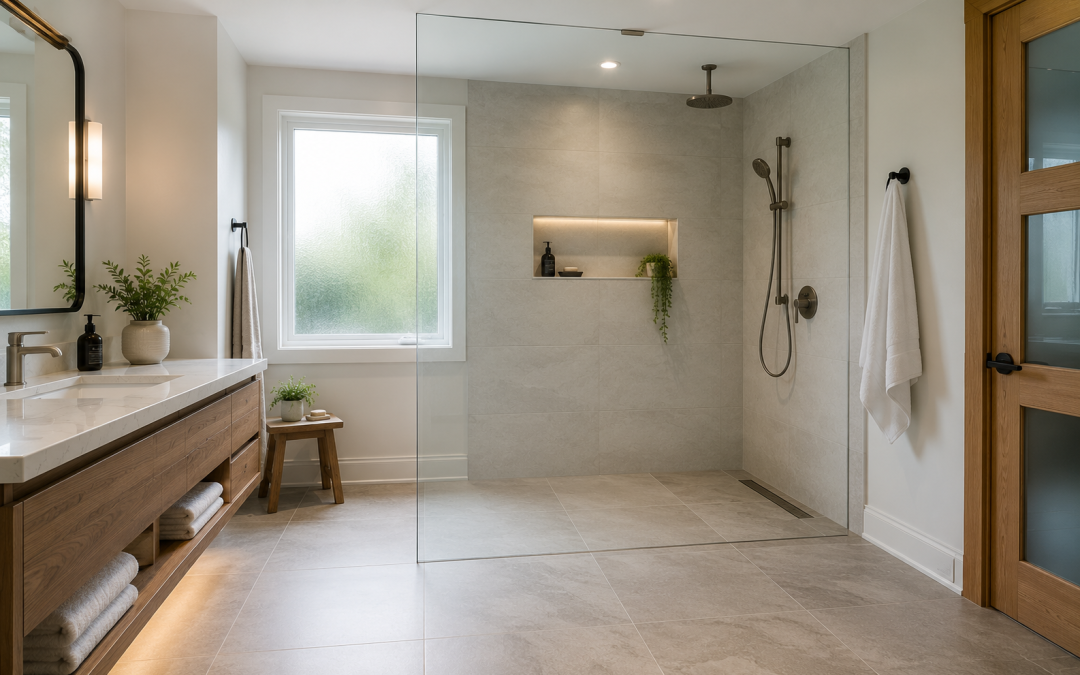
A curbless walk-in shower is a shower with no raised threshold between the bathroom floor and the shower floor — you simply walk in, with the floor sloping gently toward the drain. Paired with frameless glass panels, it’s the defining look of the modern bathroom renovation: open, seamless, easy to clean, and friendly to every age and mobility level. But going curbless changes how the glass has to be designed, measured, and installed.
Centennial Glass has been Ottawa’s glass company since 1967 and completes more than 1,000 shower installations a year, a growing share of them curbless. This guide covers what makes curbless showers different and how to get the glass right.
Why Curbless Showers Have Taken Over Renovations
The appeal goes beyond looks:
- Visual space. Without a curb and a framed door interrupting the floor, even a small bathroom reads as one continuous room. Clear glass panels let tile work run uninterrupted.
- Easy cleaning. No curb corners, no door tracks, fewer metal frames — less for soap scum to colonize.
- Accessibility and resale. A level entry works for kids, seniors, strollers of laundry, and anyone whose mobility changes over time. Buyers increasingly read curbless as “renovated properly.”
- Design flexibility. Curbless layouts pair naturally with minimal glass: a single fixed panel, a panel-and-door combination, or open “wet room” concepts.
Drainage: The Make-or-Break Detail
In a curbed shower, the curb is a dam. Remove it, and the floor itself must manage every drop. Three things have to be engineered before any glass is ordered:
- Slope. The shower floor needs a consistent fall toward the drain — typically about 2% — created by recessing the subfloor or building up the surrounding floor. This is structural work, best planned at the renovation stage.
- Drain choice. Linear drains placed against the back wall or across the entry line are popular in curbless designs because they allow a single-plane slope and large-format tile. Centre point drains work too, with a four-way slope.
- Waterproofing. The membrane must extend well beyond the wet zone, because there is no curb to stop creeping water.
Your contractor or plumber handles this layer — and we work alongside Ottawa trades constantly; see our page on glass for plumbing contractors — but the drainage plan directly shapes the glass plan, which is why we encourage homeowners to involve the glass shop before tile goes up.
Designing the Glass for a Curbless Shower
Glass for a curbless shower differs from a standard enclosure in several ways:
- Bottom edges follow the slope. Because the floor falls toward the drain, fixed panels are often cut with a slightly angled bottom edge so the gap stays even and the top stays level. This is precision work — each panel is templated and custom-fabricated. Centennial fabricates in-house, which means tight quality control and the ability to remake a piece quickly if the site changes.
- Splash control without a dam. With no curb, the glass takes over the job of keeping spray in the wet zone. A common solution is a generous fixed panel (sometimes called a shower screen) shielding the showerhead side, with an open walkway or a swinging door at the entry. A configuration like an inline swing door with panel gives full enclosure when you want maximum splash and heat retention.
- Anchoring. Panels anchor to walls and, with U-channel or clamps, to the floor — every fastener penetration through the waterproofing must be sealed correctly, another reason professional installation matters.
- Glass selection. Thicker tempered glass (10 mm is typical for frameless panels) gives fixed screens their solid, all-glass look, and an easy-clean coating keeps the showpiece panel looking new.
Open Entry or Full Enclosure?
The biggest design decision is how enclosed you want to be. A doorless walk-in is the cleanest look and the most accessible, but it needs enough run-up (roughly 1.2 m or more of depth works well) so spray dies before the opening, and it will feel airier but slightly cooler. A panel-plus-door layout keeps steam in and suits smaller footprints. Our online shower design tool — the first of its kind in Canada, developed in-house — lets you explore the configurations with your own measurements, and our guide to planning your new shower project walks through the decisions step by step.
Budgeting and Timing the Glass
Curbless glass is custom by nature — sloped edges, exact templating, site-specific anchoring — so the glass is measured after tiling is complete and fabricated to fit. Build that sequencing into your renovation timeline. Costs vary with glass thickness, panel sizes, hardware, and coatings; for a sense of the factors involved, see our overview of custom glass shower enclosure costs in Ottawa. Consultation and precise measurement are free, and every installation carries our 2-year workmanship commitment.
Walk-in projects are some of our customers’ favourites. As Mary Ann, a 5-star reviewer, wrote about her project: “…super pleased with the result… he was meticulous in his work…”
FAQ
Does a curbless shower need a door at all?
Not necessarily. With enough depth and a well-placed fixed panel, a doorless walk-in contains spray fine. Smaller footprints usually do better with a panel-and-door combination.
Will water escape a curbless shower?
Not if the floor slope, drain placement, and glass layout are designed together. The glass panel takes over the splash-control job the curb used to do.
Can my existing bathroom be converted to curbless?
Often, yes — it depends on whether the floor structure allows the shower area to be recessed for slope. A contractor confirms feasibility; we template the glass once the new floor is in.
What glass thickness is used for walk-in shower panels?
Fixed frameless panels are typically 10 mm tempered glass, which provides the rigidity a freestanding screen needs. All shower glass is tempered safety glass.
Plan Your Walk-In Shower with Ottawa’s Glass Experts
From the first measurements to the final panel, Centennial Glass has guided Ottawa homeowners through curbless projects with 55+ years of experience behind us. Call 613-738-9500 or contact Centennial Glass to book a free consultation.