

How to Hang a Heavy Mirror Safely
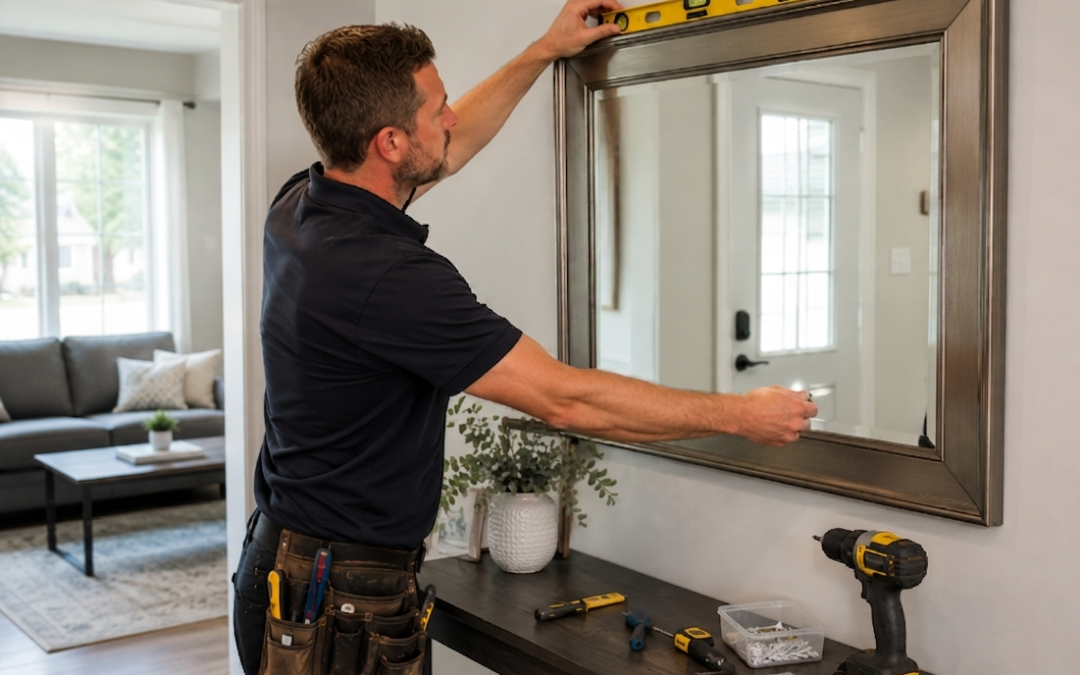
Hanging a heavy mirror safely means matching the mirror’s weight to the right wall anchor, fastening into solid structure wherever possible, and knowing the point at which the job stops being a DIY project. A mirror is not just heavy — it is heavy *glass*, so a failed hanger can mean dangerous shards, not just a dented floor. This guide covers weight thresholds, anchor types, a step-by-step method, and when a professional installer is the smarter call.
Centennial Glass has been Ottawa’s glass company since 1967, and after 55+ years of fabricating and installing custom mirrors of any size or shape, we have seen what happens when a heavy mirror is hung on the wrong hardware. Here is how to do it right.
Step 1: Know Your Mirror’s Weight
Weigh the mirror (a bathroom scale works: weigh yourself holding it, then subtract). The weight determines everything that follows:
- Under 20 lb (9 kg): A standard picture hook or two into drywall is usually adequate.
- 20–50 lb (9–23 kg): You need rated drywall anchors — toggle bolts or snap toggles — or, better, a screw into a wall stud.
- Over 50 lb (23 kg): Fasten into studs or solid masonry, ideally with a French cleat or Z-bar that spreads the load across two or more fixing points.
- Very large or frameless mirrors (full-wall pieces, mirror walls, glass over about 4 feet in any dimension): These typically are not “hung” at all — they are supported by J-channel or clips and bonded with mirror adhesive. This is professional territory.
Always buy hardware rated for at least double your mirror’s weight. Ratings assume perfect installation; real walls rarely cooperate.
Step 2: Know Your Wall
The same anchor behaves very differently in different walls:
- Drywall over wood studs (most Ottawa homes): the gold standard is screwing directly into studs, which sit every 16 inches on centre — a wide mirror can almost always reach two.
- Plaster and lath (older homes): plaster crumbles around standard anchors. Toggle bolts that grip behind the lath are the safer choice, and pilot holes prevent cracking.
- Concrete or brick (condos, basements): use sleeve anchors or concrete screws with a masonry bit. These walls hold the most weight — when anchored correctly.
- Tile: drilling tile risks cracking it, and anchors must reach the structure behind. This is one of the most common reasons customers hand the job to us.
Step 3: Choose the Right Hanger and Anchor
For framed mirrors in the 20–50 lb range, these are the reliable options:
- Toggle bolts and snap toggles spread the load behind the drywall and are the strongest hollow-wall anchors. Avoid plastic expansion plugs for anything heavy.
- French cleats (interlocking bevelled rails) are the best system for heavy framed mirrors: the load presses down and into the wall, and levelling is built in.
- Heavy-duty D-rings and braided hanging wire rated above the mirror’s weight, fixed to the frame — never rely on a single sawtooth hanger for a heavy piece.
- Two fixing points, always. Two anchors halve the load on each and stop the mirror drifting out of level.
Frameless mirrors are different: they should sit in a J-channel or on mirror clips that carry the weight mechanically, with mirror mastic bonding the back. Standard construction adhesive can attack the mirror backing — another quiet way heavy mirrors end up on the floor.
If wall anchoring is not an option at all — rental walls, concrete you cannot drill — a leaning floor mirror achieves the full-length look with anti-tip strapping instead of structural anchors.
Step 4: Hang It — the Safe Sequence
- Mark the height. Centre the mirror at about 57–60 inches from the floor, or 5–10 inches above furniture it sits over.
- Find structure. Locate studs; plan fixings to hit at least one, ideally two.
- Drill pilot holes sized to your anchors; install anchors fully flush.
- Mount the cleat or hooks dead level — use a spirit level, not your eye.
- Lift with two people. One lifts, one guides the wire or cleat into place.
- Check and re-check. Press gently downward to verify the anchors hold before letting go.
When to Call a Professional Installer
Be honest about the threshold between a Saturday project and a glass-handling job. Call a professional when:
- The mirror weighs over 50 lb or exceeds about 4 feet in any dimension
- It is frameless and needs channel, clips, and mirror-safe adhesive
- It is going onto tile, into a stairwell, or above a vanity, bed, or sofa where a failure would be dangerous
- The wall is plaster, concrete, or of unknown construction
- You want a mirror wall or a custom-cut piece sized to the space — covered in our guide to unique ways to use mirrors in your home
Professional installers arrive with the glass-handling equipment, the right anchors for your wall, and the experience of doing this daily. Barry Wood’s 5-star review sums up what that looks like:
“Thomas & Dylan installed a large (8′ wide) mirror perfectly, quickly, and professionally. Great service, and a great result!” — Barry Wood, 5★
And for big custom pieces, the value shows from measuring through mounting, as queenie huynh described:
“Thank you everyone at Centennial Glass for a completely wonderful experience in getting a beautiful new 5′ x 7′ custom wall mirror installed in my condo… every step was solid, friendly, professional, and worth every penny of a totally fair price.” — queenie huynh, 5★
Because we fabricate in-house, we can also cut a new mirror to the exact size your wall needs instead of forcing a stock size to fit — part of our full range of glass services, with no project too large or too small.
FAQ
How heavy is too heavy for drywall alone?
Above roughly 20 lb, do not trust bare drywall with plastic plugs. Use toggle-style anchors rated well beyond the mirror’s weight, and above 50 lb, fasten into studs or masonry.
Can I use Command strips or adhesive hooks for a heavy mirror?
No. Adhesive strips are rated for light frames under ideal conditions, and humidity and temperature swings degrade them. A falling mirror is a glass hazard — use mechanical anchors.
How do you hang a frameless mirror?
Frameless mirrors are supported by J-channel or mirror clips that carry the weight, with mirror mastic bonding the back of the glass. They are not hung on wire. Large frameless pieces should be professionally installed.
What height should a heavy mirror be hung?
Centre it at 57–60 inches from the floor (gallery height), or 5–10 inches above a console, vanity, or sofa back.
Need a Heavy Mirror Installed in Ottawa?
Skip the guesswork — and the risk. Centennial Glass measures, fabricates, delivers, and installs mirrors of any size, backed by 55+ years of experience. Call us at 613-738-9500 or contact Centennial Glass for a quick quote.