

Why Shower Doors Shatter Spontaneously (and How to Prevent It)
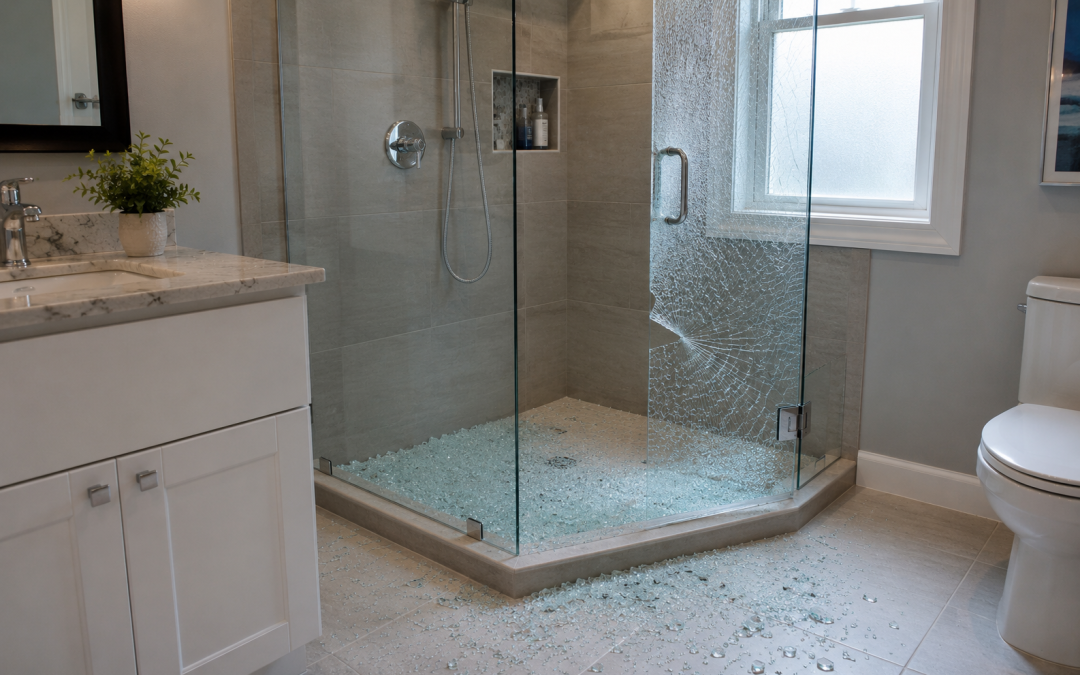
Spontaneous glass breakage is the sudden shattering of tempered glass without any apparent impact — a shower door that bursts into thousands of small pieces while no one is touching it. It’s a startling event, but it’s also rare, well understood by the glass industry, and largely preventable through quality fabrication, careful installation, and a little routine attention. Here’s the science, explained without alarm.
Centennial Glass has fabricated and installed glass in Ottawa since 1967, including more than 1,000 shower installations every year, so questions about tempered glass safety land on our counter regularly. This article covers why shower doors use tempered glass, why it very occasionally fails on its own, and what actually reduces the risk.
Why Shower Doors Use Tempered Glass in the First Place
Tempered glass is safety glass that has been heat-treated to be several times stronger than ordinary annealed glass and to break into small, blunt-edged pebbles instead of dagger-like shards. Building codes require tempered safety glass in human impact areas — and a shower, where wet skin meets glass at close quarters, is the textbook example. Every legitimate shower door sold in Canada is tempered.
The tempering process heats glass close to its softening point and then cools the surfaces rapidly. This locks the outer surfaces in compression and the core in tension. That stored energy is exactly what makes tempered glass so strong — and it’s also why, when tempered glass does fail, it fails completely and all at once. The dramatic “explosion” people describe is the safety feature working: the whole panel converts to small granular pieces rather than large shards.
What Actually Causes “Spontaneous” Shattering
When a shower door shatters with nobody near it, one of a few things has usually happened — and most of them aren’t truly spontaneous.
Nickel sulfide inclusions
Deep inside any batch of float glass there can be microscopic contaminant particles, the best known being nickel sulfide. These particles are harmless in ordinary glass, but tempering changes them. Rapid cooling freezes a nickel sulfide particle in a compact, high-temperature form; over the following months or years it slowly converts back to its low-temperature form, which is about 2–4% larger. If the particle happens to sit in the tensile core of the tempered panel, that tiny expansion can one day initiate a crack — and because tempered glass holds so much stored energy, the whole panel lets go at once. This can occur months or even years after installation, with no warning and no external cause. It is a known, industry-recognized phenomenon, and it is uncommon: inclusions large enough to cause failure occur in a small fraction of glass panels, and only a portion of those sit in the critical zone.
Edge and surface damage
Far more failures trace back to a hard knock the glass took earlier — a chipped edge during a renovation, a nick from a metal hinge installed without proper isolation, or a deep scratch. Tempered glass is strongest across its faces and most vulnerable at its edges. Damage there can quietly grow under daily temperature swings until the panel fails, sometimes long after the original knock.
Hardware stress
Glass-to-metal contact is a slow-motion failure waiting to happen. Quality shower door hinges and clamps use gaskets and bushings so metal never touches glass directly. Over-tightened hardware, missing gaskets, or a door that has dropped and grinds on its curb all concentrate stress at exactly the points tempered glass tolerates least.
Thermal stress
Hot water on cold glass produces expansion differences across the panel. Properly tempered glass handles normal shower temperature swings easily, so thermal stress is rarely the sole cause — but it can be the final straw for a panel already stressed by an edge chip or pinching hardware.
How to Reduce the Risk
You cannot inspect for a nickel sulfide inclusion — it’s microscopic and buried inside the glass — but you can control everything else:
- Buy quality glass from a reputable fabricator. Clean raw glass, proper tempering, and finished edges matter. Centennial fabricates in-house, which gives us direct quality control over cutting, edging, and polishing before anything is installed.
- Insist on professional installation. Correct gasketing, torque, clearances, and plumb alignment prevent the stress concentrations behind most failures.
- Check the hardware yearly. If the door has sagged, grinds, or clunks, have it adjusted before metal-on-glass contact develops.
- Treat chips seriously. A chipped edge or deep impact mark on tempered glass can’t be repaired — have the panel assessed and, if needed, replaced.
- Don’t slam the door, and keep towel bars and handles from striking adjacent panels.
When choosing a new enclosure, design plays a role too — our comparison of frameless vs. framed shower enclosures covers how each style supports and protects the glass.
If Your Shower Door Has Shattered
Don’t panic, and don’t walk barefoot. Tempered fragments are blunt by design but can still nick skin. Put on shoes, photograph the scene for any warranty or insurance claim, and sweep and vacuum thoroughly — fragments travel far. Then call a glass professional to clear the opening, inspect the surviving panels and hardware, and measure for replacement glass. Our glass shower enclosures team handles glass-only replacements regularly; the existing hardware can often be reused.
Quality Is the Best Prevention
Spontaneous breakage makes headlines precisely because it’s unusual. The everyday reality is that well-fabricated, well-installed tempered glass gives decades of safe service. That’s where an experienced installer earns their fee — as KERRY-LYN, one of our 5-star reviewers, wrote: “it was perfectly cut and the installer Stephane was clearly an expert at his trade. This company takes pride in their products and service.” For more answers on glass thickness and safety, see our glass shower FAQ.
FAQ
Can a shower door really shatter on its own?
Yes, but rarely. The usual hidden causes are a microscopic nickel sulfide inclusion expanding inside the glass, or older edge damage and hardware stress finally reaching a breaking point.
Is tempered glass dangerous when it breaks?
It’s designed to be the opposite. Tempered glass breaks into small, relatively blunt granules instead of large shards — that’s why building codes require it in showers.
Should I worry about my existing shower door?
No need for worry — just maintenance. Check yearly that the door swings true, the hardware is snug but not grinding, and the edges are free of chips. Have any sagging or chipping looked at promptly.
Does laminated glass prevent spontaneous breakage?
Laminated glass holds its fragments on an interlayer when broken, so the panel stays in place. It’s used where fallout must be contained; for residential showers, quality tempered glass with proper installation is the standard solution.
Questions About Your Shower Glass?
If your shower door has shattered, sagged, or chipped — or you simply want a second opinion on an aging enclosure — call Centennial Glass at 613-738-9500 or contact Centennial Glass. With 55+ years in Ottawa and in-house fabrication, we’ll get you a safe, properly installed replacement quickly.