


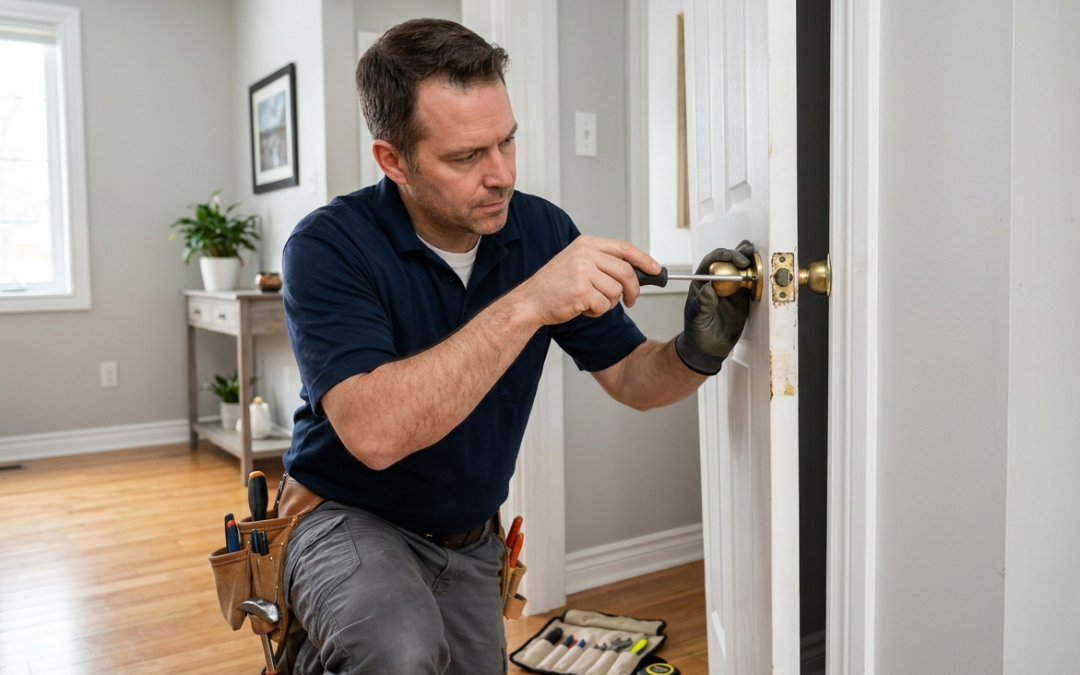
A door that won’t latch is a door whose latch bolt no longer lines up with the opening in the strike plate on the frame. The cause is almost always one of four things: a misaligned strike plate, sagging or worn hinges, a swollen or shifted frame, or a failing lock mechanism. Because the fix depends entirely on which of these is at fault, the first job is a careful diagnosis — and most of it can be done with nothing more than your eyes and a strip of lipstick or masking tape.
Centennial Glass has been repairing doors, windows, and their hardware in Ottawa since 1967. Here is the troubleshooting sequence our technicians use, plus guidance on when a latch problem signals something bigger.
First, Find Out Where the Latch Is Missing
Close the door slowly and watch where the latch bolt meets the strike plate. If you can’t see it clearly, rub a little lipstick or crayon on the latch bolt, close the door, and check where the mark lands on the strike plate:
- Mark is too high or too low: the door has sagged or the frame has shifted — look at the hinges first.
- Mark is centred but the latch won’t catch: the strike opening may be too shallow, or the door isn’t closing far enough into the frame (check weatherstripping and warping).
- Latch doesn’t reach the plate at all: the gap between door and frame has grown, often from foundation settling or a loose hinge side.
Fix 1: Adjust the Strike Plate
If the latch is missing the strike opening by a few millimetres, the simplest fix is to adjust the strike plate. Options, from least to most invasive:
- File the strike opening slightly larger in the direction of the miss.
- Move the plate. Remove the screws, fill the old holes with glued toothpicks or dowel, and remount the plate a few millimetres up or down.
- Shim or deepen the mortise if the plate sits too proud or too deep for the latch to seat.
This solves a large share of “won’t latch” complaints — but if the door sagged because of its hinges, the problem will come back.
Fix 2: Tighten or Replace the Hinges
A sagging door is the classic cause of a latch that strikes too low. Open the door and lift up on the handle: if you feel movement at the hinges, they are loose or worn.
- Tighten all hinge screws. If a screw spins without biting, replace it with a longer screw that reaches the wall stud behind the frame.
- Check for worn hinge knuckles or bent leaves — a door that has dropped even a few millimetres at the top hinge will miss its strike.
When hinges are worn out, bent, or rusted, replacement is straightforward and inexpensive compared to living with a door that never closes right. Centennial Glass stocks and installs replacement door hinges for residential and commercial doors, and our parts counter carries hardware for most major brands.
Fix 3: Look at the Lock and Latch Mechanism Itself
If alignment looks fine but the latch bolt is sticky, sluggish, or doesn’t spring out fully, the mechanism is the problem. Latch bolts gum up with old lubricant and dust, springs weaken, and entry-door locks simply wear out with decades of use. A shot of dry graphite or silicone lubricant may revive a sticky latch; a worn mechanism should be replaced.
Patio doors, garden doors, and many newer entry doors use multi-point handles that latch at two or three points along the door edge. When one point falls out of adjustment, the whole door can refuse to close or lock. These mechanisms are repairable, but parts vary widely by manufacturer — matching the right gearbox or keeper is the hard part.
Fix 4: Seasonal Swelling and Frame Movement
In Ottawa’s climate, doors that latch perfectly in February can refuse to close in a humid July. Wood doors and frames absorb moisture and swell; extreme cold can shift frames the other way. If your latch problem is seasonal, avoid drastic changes (like aggressively moving a strike plate) based on the door’s worst week of the year — a modest strike adjustment plus fresh weatherstripping is usually the better answer. A door that suddenly stops latching after years of working, with visible frame gaps or cracking, deserves a professional look, as it can indicate structural movement.
When to Bring in a Professional
Call a door specialist when you’ve adjusted the strike and tightened the hinges and the door still won’t latch, when a multi-point mechanism has failed, or when the frame itself is damaged. Businesses should act quickly: a commercial door that won’t latch is a security problem, which is why we offer commercial door glass and hardware repair with same-day service for many repairs, backed by 24/7 emergency availability across the Ottawa region.
Many customers solve hardware problems with help from our window and door parts counter — sometimes without a service call at all. As Jean-Pascal Souque wrote in his 5-star review: “I had to change the lock of the kitchen sliding door. I e-mailed Centennial Glass with 2 pics attached, and Kim found a lock, but she kept asking questions to figure out what the problem was.”
FAQ: Doors That Won’t Latch
Why won’t my door latch even though it closes?
The latch bolt is missing the opening in the strike plate, usually because the door has sagged on its hinges or the frame has shifted. Mark the latch with lipstick, close the door, and see where the mark lands to find the direction of the miss.
How do I fix a door latch that is misaligned?
If the miss is small, file the strike plate opening slightly larger. For a bigger miss, reposition the strike plate, or fix the root cause by tightening or replacing sagging hinges.
Why does my door only stick in summer?
Humidity makes wood doors and frames swell, narrowing clearances so the latch and door edge bind. Seasonal sticking usually calls for a modest strike adjustment and fresh weatherstripping rather than major changes.
Can a multi-point lock be repaired instead of replacing the door?
Yes. Multi-point mechanisms, handles, keepers, and gearboxes are replaceable components. The door and frame stay; only the failed hardware is swapped, provided the correct parts can be matched.
Get That Door Closing Properly Again
A door that won’t latch is more than an annoyance — it’s lost security, lost heat, and a daily frustration. Call us at 613-738-9500 or contact Centennial Glass and we’ll diagnose the latch, hinge, or lock problem and fix it right.