


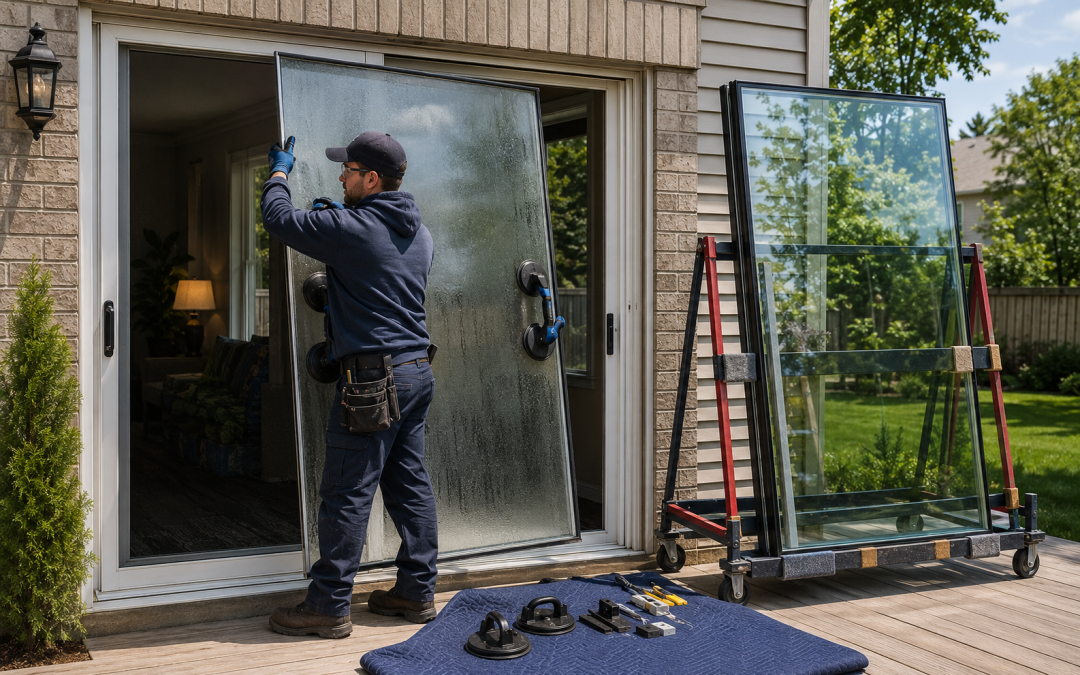
Foggy glass in a patio door is condensation or haze trapped *between* the two panes of the insulated glass unit, and it means the unit’s edge seal has failed. No amount of cleaning will fix it, because the moisture is inside the sealed airspace where no cloth can reach. The permanent fix is also a surprisingly contained one: the failed sealed unit is removed from the door panel and a new one is installed in its place. The door itself, with its frame, rollers, and hardware, stays exactly where it is.
Centennial Glass has been replacing sealed units in Ottawa doors and windows since 1967. Here’s why patio door glass fogs up, why it doesn’t mean you need a new door, and what the glass-only fix involves.
What’s Actually Inside Patio Door Glass
A modern patio door holds an insulated glass unit (also called a sealed unit or thermopane): two panes of tempered glass bonded around a perimeter spacer, with the airspace between them sealed and often filled with argon gas. A desiccant inside the spacer keeps that airspace bone-dry, which is what keeps the glass clear and insulating.
The unit’s performance depends entirely on the edge seal. While the seal holds, the cavity stays dry. When it fails, humid air migrates in, the desiccant saturates, and moisture begins condensing on the inner glass surfaces, first as intermittent morning fog, eventually as permanent haze, droplets, or white mineral staining.
Why Patio Door Seals Fail
Patio doors are among the hardest-working sealed units in a house:
- Thermal pumping. Daily heating and cooling makes the glass panes flex in and out, constantly working the edge seal. Ottawa’s large temperature swings, from -30°C winters to hot summer sun on a south-facing door, accelerate this.
- Sun exposure. UV and heat degrade older sealants over time.
- Vibration and slamming. A sliding door moves and shudders every day, stressing the seal in a way a fixed window never experiences.
- Water at the sill. Drainage problems can leave the bottom edge of the unit sitting in moisture, attacking the seal from outside.
Seal failure is a normal end-of-life event for an insulated glass unit, not a sign the door was defective, though units do age faster on high-exposure orientations.
The Fix: Replace the Glass, Keep the Door
Because the sealed unit is a discrete component held in the door panel by glazing stops, it can be replaced on its own through a sealed unit or thermopane replacement. The process:
- Assessment and measurement. A technician confirms the seal has failed and measures the unit precisely: width, height, glass and airspace thickness.
- Fabrication. A new tempered sealed unit is built to those dimensions. Centennial Glass fabricates in-house, which means quality control on every unit and faster turnaround than shops that outsource.
- Installation. The stops are removed, the failed unit comes out, the new unit is set, sealed, and re-stopped. The door panel usually never leaves its track, and the work is typically done in well under a day.
You can read more about how this service works on our foggy windows and sealed unit replacement FAQ page. The principle is identical for doors, with the addition that door glass must be tempered safety glass by code.
It’s also a chance to upgrade: the replacement unit can be ordered with low-E coating and argon fill, so a door that fogged up with 1990s glass comes back clearer *and* more efficient than it ever was. Our overview on getting rid of foggy windows covers the upgrade options in more detail.
Repair or Replace: How to Decide
Replacing the sealed unit is the right call when the door rolls, latches, and seals properly and the only problem is the glass, which describes most foggy patio doors we see. Consider full door replacement instead when the frame is rotted or warped, rollers and hardware are failing together and parts are obsolete, or you want a different style or size of door anyway.
Because Centennial Glass does both glass and window repair and full door installation, you’ll get a straight answer rather than a sales pitch. We’ve stayed in business for over 55 years by recommending the fix that makes sense, with no project too large or too small. Many smaller repairs qualify for same-day service, and our line is answered 24/7 for emergencies across the Ottawa region.
Here’s David myer’s 5-star experience with this exact service: “Excellent service for replacing sealed glass units. Jordan and Tony did the installation quickly and cleanly, very professional.”
FAQ: Foggy Patio Door Glass
Why is my patio door glass foggy between the panes?
The insulated glass unit’s edge seal has failed, letting humid air into the sealed airspace. The internal desiccant saturates, and moisture condenses on the inside glass surfaces where it can’t be wiped away.
Can foggy patio door glass be fixed without replacing the door?
Yes. The sealed unit is a separate component held in the door by glazing stops. A new tempered sealed unit is fabricated to the same dimensions and installed in the existing door panel.
Can you just clean or defog the glass instead?
Defogging services that drill the glass address the visible moisture, not the failed seal or saturated desiccant, so the insulating performance isn’t restored. Replacing the sealed unit is the lasting fix and the approach we recommend.
Does new sealed glass improve energy efficiency?
Yes. A fogged unit has lost its insulating performance, and replacing it restores the airspace. It also lets you upgrade to low-E coated, argon-filled glass that outperforms the original unit.
Clear Glass, Same Door
A foggy patio door blocks the very view it was built for, and the fix is simpler than most homeowners expect. Call us at 613-738-9500 or contact Centennial Glass to book a sealed unit assessment and quote for your patio door.