


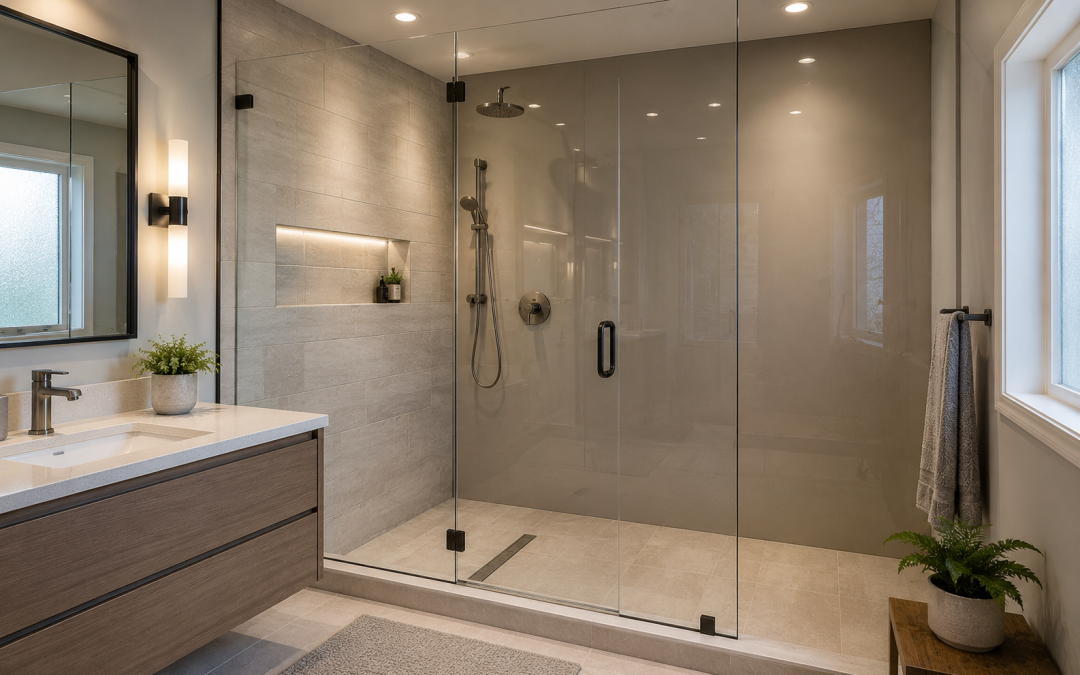
Glass shower walls and tile are the two main ways to enclose and finish a shower, and they solve different problems. Tile is the traditional surface for the wet walls themselves; glass is the transparent enclosure, and increasingly, a wall surface in its own right. Most modern showers actually use both: tiled wet walls with a glass enclosure. This guide compares the two honestly on cost drivers, maintenance, durability, and design, so you can decide where each belongs in your renovation.
Centennial Glass has worked on Ottawa bathrooms since 1967 and completes more than 1,000 shower installations a year, so we see how these choices play out over decades, not just on installation day.
What Each Material Does Best
Tile offers nearly unlimited pattern, colour, and texture; it’s repairable piece by piece; and it’s the proven finish for floors and structural wet walls. Its weakness is the grout between the tiles, porous, stain-prone, and the part everyone ends up scrubbing.
Glass offers transparency and light. A clear enclosure makes a small bathroom feel dramatically bigger, one of the three reasons to choose a glass shower enclosure we hear from customers most often. As a surface, glass is non-porous and grout-free: a single glass panel has no joints to stain. Its trade-off is that it’s custom-fabricated, so changes after fabrication mean new glass.
Cost: What Actually Drives the Price
We won’t quote dollar figures here, because both materials span a huge range, but the cost structures differ in useful ways:
- Tile costs scale with labour. The tile itself can be modest, but surface preparation, waterproofing, setting, and grouting are skilled, time-intensive work. Intricate patterns and small tiles push labour up fast.
- Glass costs scale with fabrication and size. Tempered glass panels are priced largely by glass thickness, square footage, edgework, and hardware. A simple fixed panel sits at the low end; full frameless enclosures with premium hardware sit higher. Our overview of custom glass shower enclosure costs in Ottawa breaks down the factors.
- Lifetime cost favours fewer joints. Grout needs periodic sealing and eventual regrouting; failed grout can mean water damage repairs. Glass needs none of that, which narrows any upfront gap over the years.
Because every project mixes the two differently, the meaningful comparison is your layout, not a generic figure. A free consultation with precise measurements settles it quickly.
Maintenance: Grout Lines vs Water Spots
This is where the everyday difference lives.
Tile maintenance is really grout maintenance: sealing roughly annually, scrubbing lines that trap soap and mildew, and touching up caulk at changes of plane. Large-format tile reduces grout but never eliminates it.
Glass maintenance is water-spot management: a thirty-second squeegee pass after showering, plus an occasional vinegar-and-water clean. With an easy-clean protective treatment, which guards against soap scum, hard water, and lime scaling, cleaning time can drop by up to 90%. There are no joints to reseal and nothing to regrout, ever.
If scrubbing grout is the chore you most want to retire, weight your design toward larger glass surfaces and larger tiles.
Durability and Repairs
Tempered shower glass is safety glass several times stronger than ordinary glass; it doesn’t stain, fade, or absorb water, and quality hardware keeps doors swinging true for decades (Centennial backs installations with a 2-year workmanship commitment). If a panel is ever damaged, it’s replaced as a unit, usually with the existing hardware reused.
Tile is durable too, and individually repairable: one cracked tile can be cut out and replaced if you kept spares. Its long-term vulnerabilities are grout failure and substrate movement, which show up as staining or loose tiles.
The Hybrid Most Bathrooms Land On
For the majority of renovations, the winning formula is tiled wet walls plus a frameless or semi-frameless glass enclosure: tile where the water hits and design personality matters, glass where light and openness matter. From there, the main decision is enclosure style. Our guide to frameless vs. framed shower enclosures compares the looks, budgets, and water-management trade-offs. Going heavier on glass (full-height panels, minimal tile) suits ultra-modern designs and grout-averse owners; going heavier on tile suits traditional and pattern-rich designs.
Whichever way you lean, ordering custom glass has its own checklist: measurements, glass type, edgework, hardware. It’s covered in what to consider before ordering custom glass.
Deciding for Your Bathroom
Bring photos and rough dimensions to a consultation and the trade-offs get concrete fast. Centennial fabricates glass in-house, which means direct quality control and faster turnaround than shops that outsource. The end result is what matters. As Guy, a 5-star reviewer, wrote: “We had Centennial Glass come in and build a custom glass enclosure for the shower. It turned out beautiful.”
FAQ
Is a glass shower cheaper than tile?
Neither is automatically cheaper. Tile costs are labour-driven while glass costs are fabrication-driven. Compare quotes for your specific layout rather than relying on generic figures.
Are glass shower walls hard to keep clean?
They’re generally easier than tile: no grout lines, just a quick squeegee after use. An easy-clean coating reduces maintenance further, up to 90% less cleaning time.
Can you combine glass walls and tile?
Yes, it’s the most common approach: tiled wet walls with a glass enclosure or partial glass panels. You get tile’s design range with glass’s openness and low upkeep.
How long do glass shower walls last?
Tempered glass panels routinely last the life of the bathroom. Wear items are the seals, sweeps, and hardware, which are inexpensive to replace as needed.
Get a Real Comparison for Your Project
Skip the guesswork. Have us look at your layout and price the glass portion precisely. Call Centennial Glass at 613-738-9500 or contact Centennial Glass for a free consultation.